

Resource model and modes
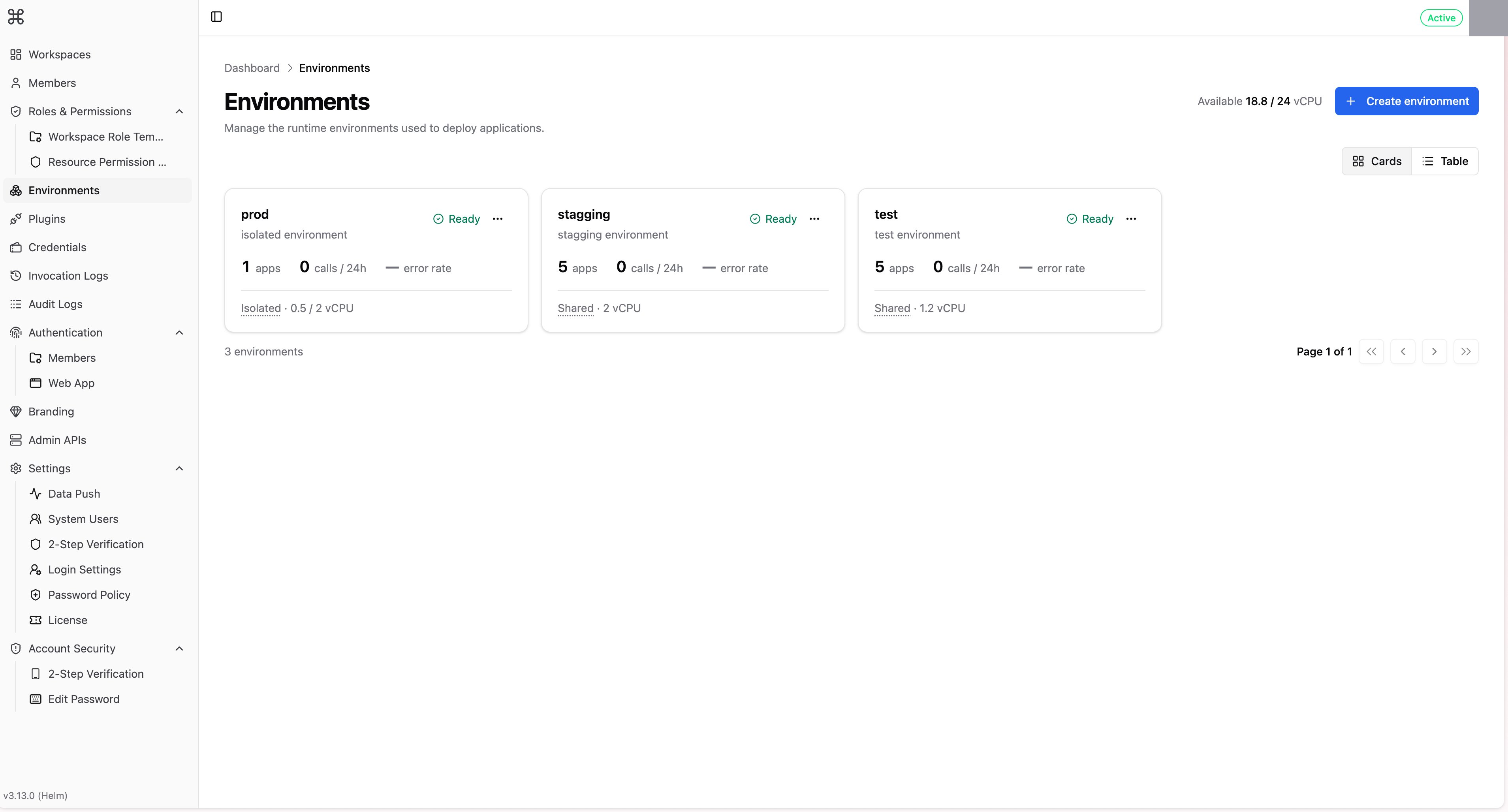
The platform’s total CPU quota is determined by the license. When creating an environment, set CPU allocation using the platform’s available quota to create a CPU resource pool for applications in that environment. Regardless of whether applications are deployed in the environment, the quota allocated to an environment counts toward the platform’s allocated quota. Environments that have failed or are being deleted don’t count. Both shared and isolated modes use the environment’s resource pool; the difference lies in how applications run and how resources in the pool are allocated.
For example, if the platform total quota is 24 vCPU, after creating an environment with a CPU allocation of 4 vCPU, the platform has 20 vCPU remaining to allocate to other environments:
- Shared mode: All applications in the environment share these 4 vCPU.
- Isolated mode: After allocating 1 vCPU each to Application A and Application B, 2 vCPU remains available in the environment resource pool. The platform’s available quota remains 20 vCPU and is not deducted again for application allocations.
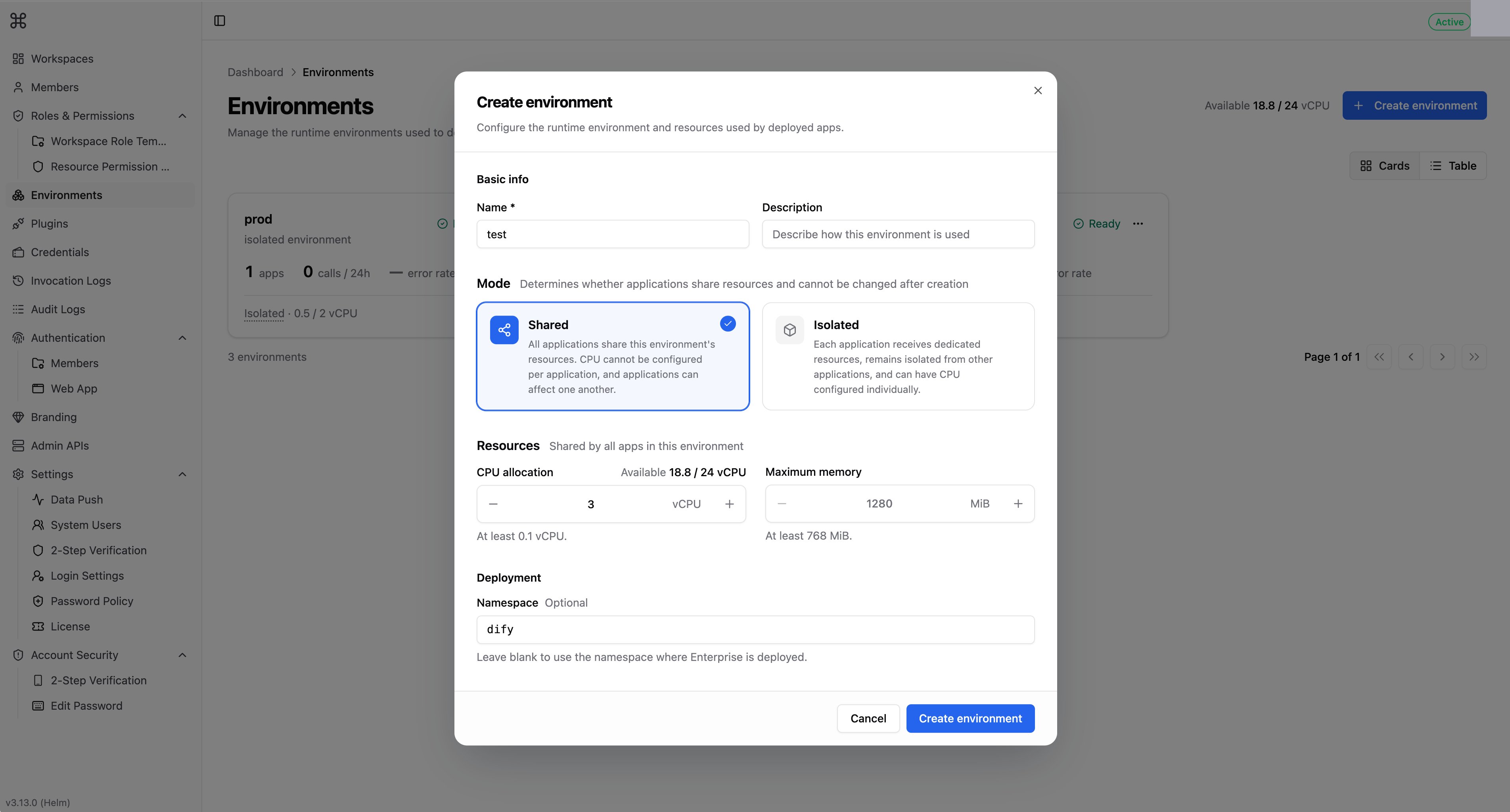
Create environment
Click Create environment in the top right corner of the page and fill in the following information:
After completing the configuration, click Create environment.
Environment status
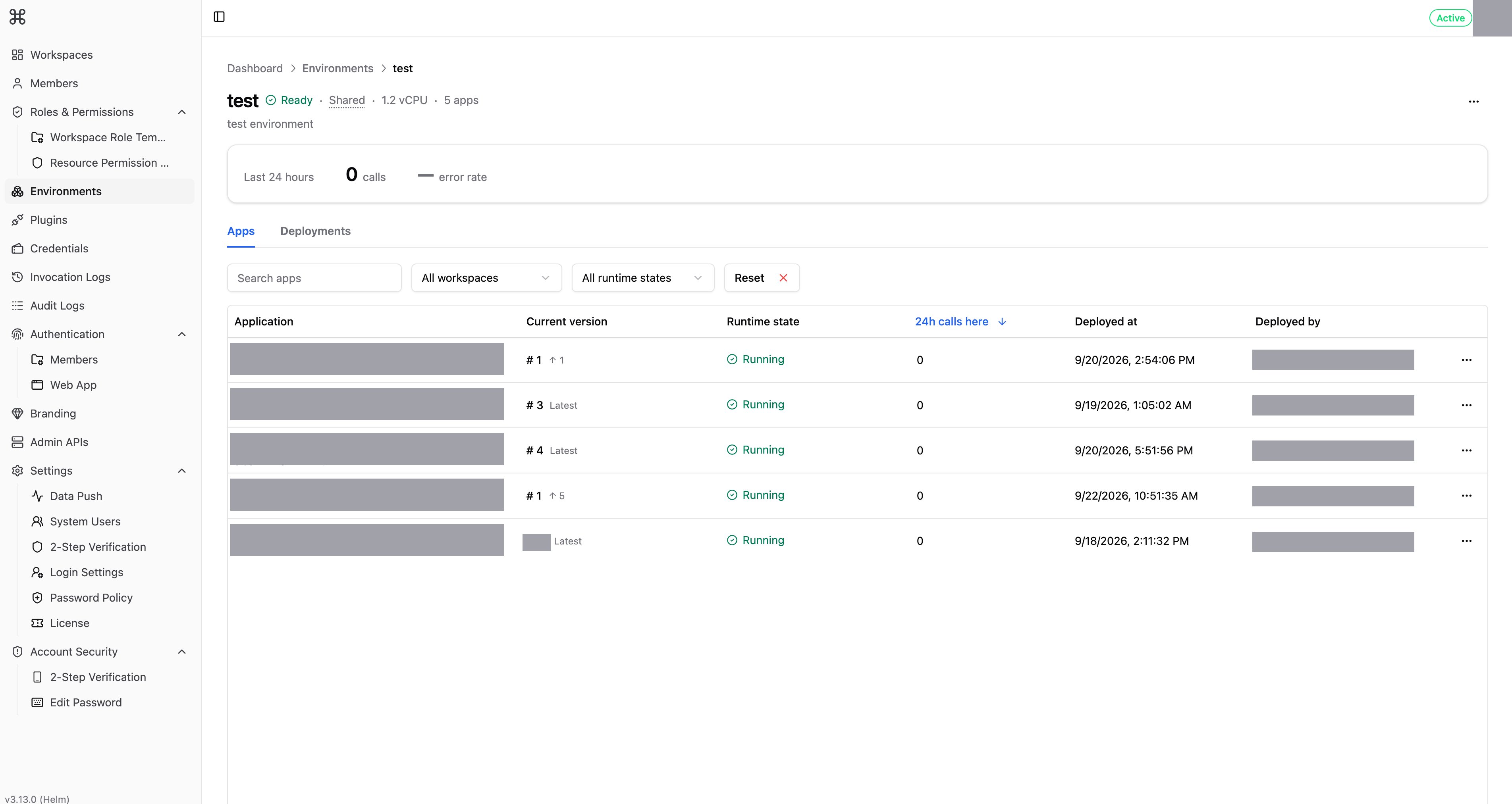
The environment list supports two views, Cards and Table, displaying resource allocations and runtime metrics for the last 24 hours:- 24h calls and Error rate: Error rate is the ratio of failed calls to total calls. When there are no calls in the last 24 hours, the error rate shows
—. - CPU allocation: Isolated mode displays “allocated / quota” to show how much of the resource pool has been allocated; shared mode displays only the quota.
- 24h failed deploys: Click the number to open those deployments and their failure reasons in Deployments.
Deployments
Open the Deployments tab on the environment details page to filter by application, time range (default Last 7 days), operation type, and status.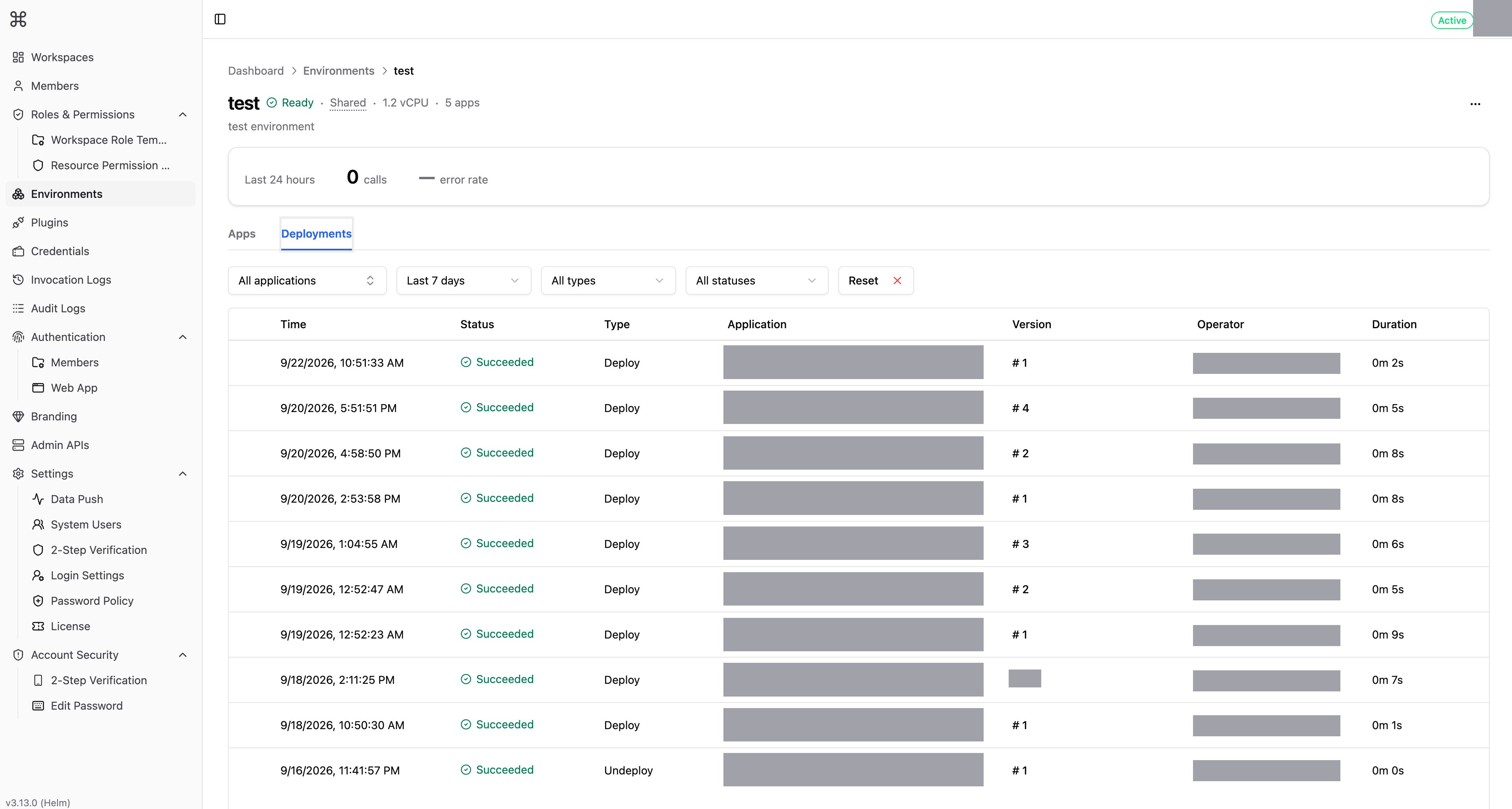
Edit environment
Select Edit from the … menu on an environment card, at the end of a table row, or in the top right corner of the details page. You can modify the name, description, and resource configuration. Mode and namespace cannot be changed after creation; if changes are required, recreate the environment. Resource configurations supported by each mode are as follows:- Shared mode: You can modify CPU allocation and Maximum memory, following the same rules as during creation. Increasing CPU raises the minimum memory requirement; if the currently configured maximum memory is below the new minimum, the form prompts you to increase memory first.
- Isolated mode: Supports modifying only the CPU allocation, which is the resource pool size. When decreasing it, the allocation cannot be lower than the amount already held by applications. To release quota, first decrease application CPU allocations or undeploy applications. Adjusting the resource pool size does not restart applications in the environment.
Adjust resources per application
Isolated mode supports configuring CPU and memory individually for each application. On the Apps tab of the environment details page, click the … menu at the end of the target application row and select Edit resources. Shared mode does not support adjusting resources per application; modify environment resources via Edit environment.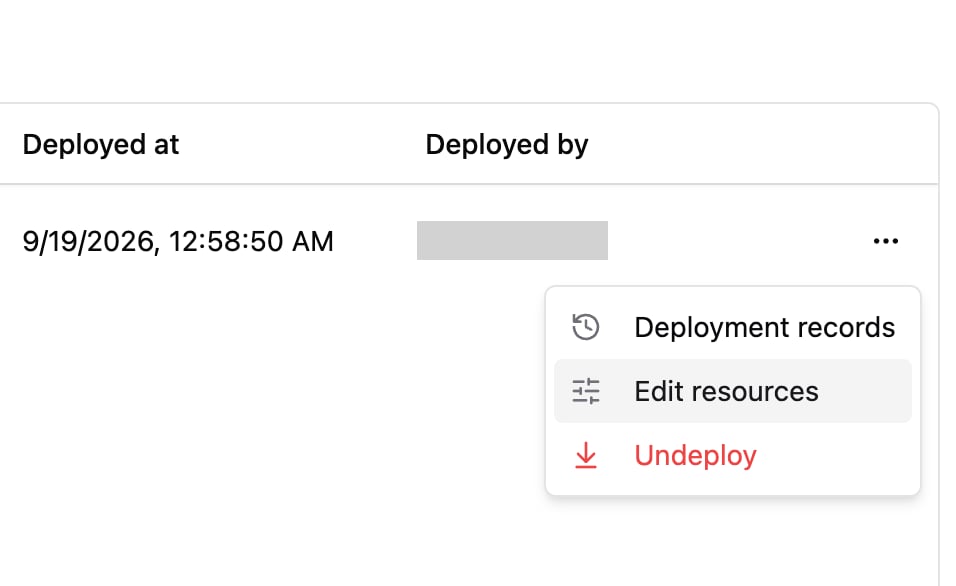
- CPU: At least 0.1 vCPU, and cannot exceed the environment quota minus the CPU allocated to other applications. Applications are allocated 0.5 vCPU by default upon deployment. Selecting a CPU quota during deployment is not supported; adjust it via Edit resources.
- Maximum memory: Cannot be lower than the minimum displayed in the form, which is determined by the application’s current CPU allocation; if left blank, the system derives a default value based on CPU. Increasing CPU raises the minimum requirement; if the currently configured maximum memory is below the new minimum, the form prompts you to increase memory first.