

Create an Application Integrated with Knowledge Base
A knowledge base can be used as an external information source to provide precise answers to user questions via LLM. You can associate an existing knowledge base with any application type in Dify. Taking a chat assistant as an example, the process is as follows:- Go to Knowledge > Create Knowledge > Upload file.
- Go to Studio > Create Application and select Chatbot.
- Enter Context, click Add, and select one of the knowledge bases you created.
- In Context Settings, configure the Retrieval Setting.
- In Add Features, enable Citation and Attribution.
- In Debug and Preview, input user questions related to the knowledge base for debugging.
- After debugging, click Publish to create an AI application based on your own knowledge base.
Connect Knowledge and Set Retrieval Mode
In applications that utilize multiple knowledge bases, it is essential to configure the retrieval mode to enhance the precision of retrieved content. To set the retrieval mode for the knowledge bases, navigate to Context > Retrieval Settings > Rerank Setting.Retrieval Setting
The retriever scans all knowledge bases linked to the application for text content relevant to the user’s question. The results are then consolidated. Below is the technical flowchart for the Multi-path Retrieval mode: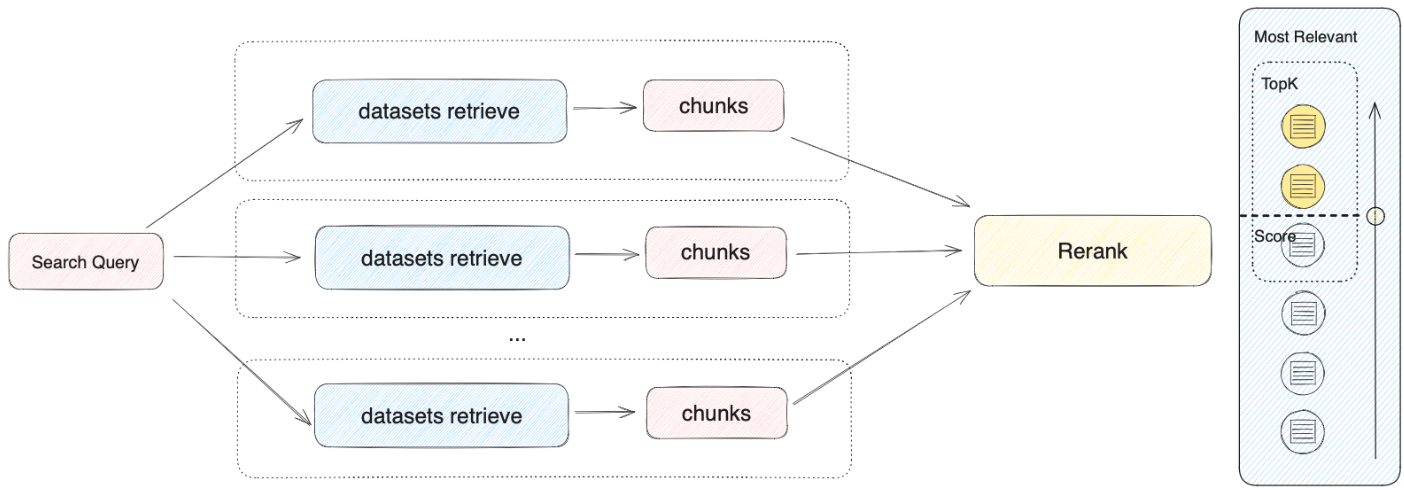
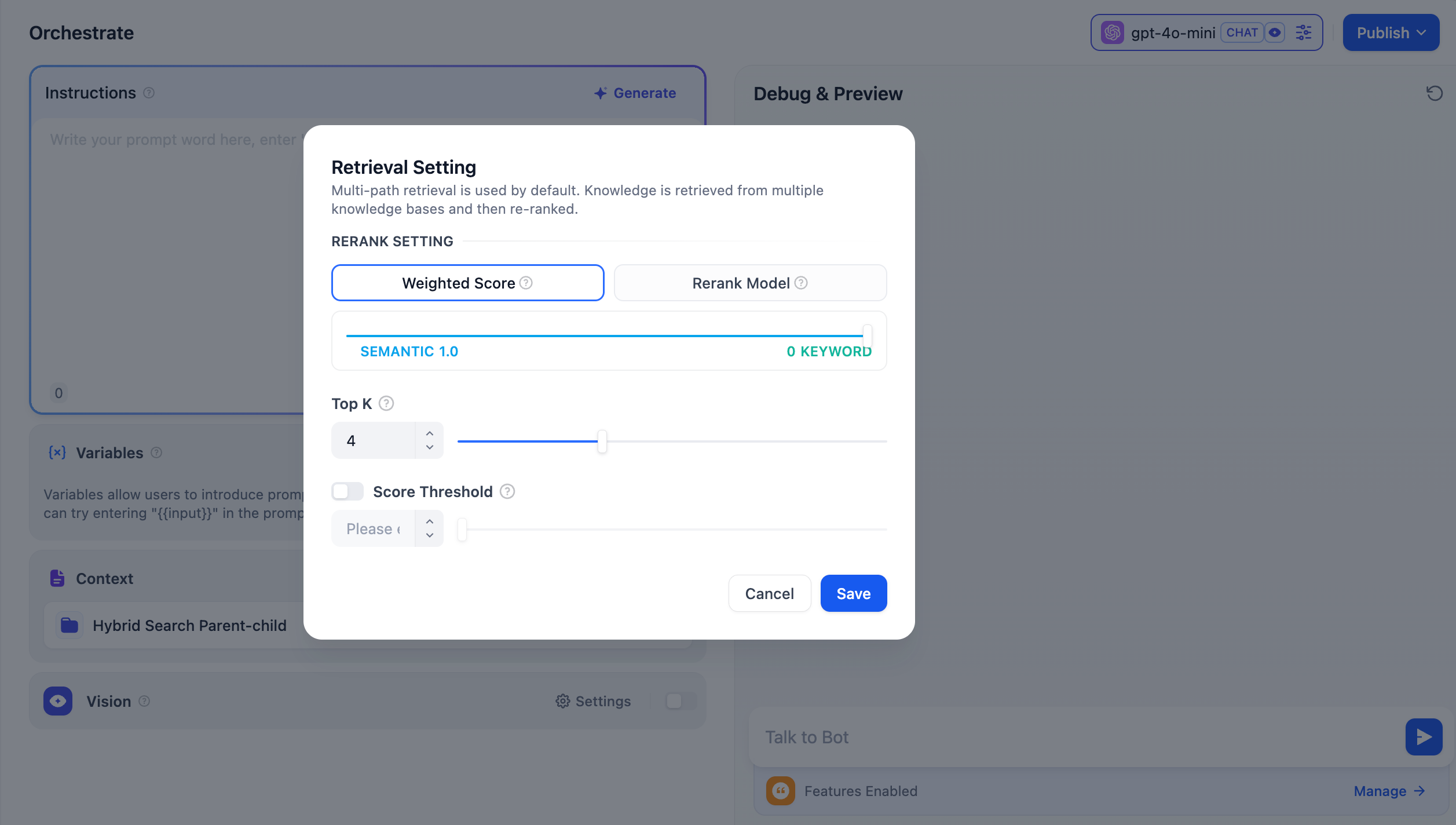
- Semantic Value of 1 This mode activates semantic retrieval only. By utilizing the Embedding model, the search depth can be enhanced even if the exact words from the query do not appear in the knowledge base, as it calculates vector distances to return the relevant content. Furthermore, when dealing with multilingual content, semantic retrieval can capture meanings across different languages, yielding more accurate cross-language search results.
- Keyword Value of 1 This mode activates keyword retrieval only. It matches the user’s input text against the full text of the knowledge base, making it ideal for scenarios where the user knows the exact information or terminology. This method is resource-efficient, making it suitable for quickly retrieving information from large document repositories.
- Custom Keyword and Semantic Weights In addition to enabling only semantic or keyword retrieval modes, we offer flexible custom Weight Score. You can determine the best weight ratio for your business scenario by continuously adjusting the weights of both.
- Top K: Determines how many text chunks, deemed most similar to the user’s query, are retrieved. It also automatically adjusts the number of chunks based on the chosen model’s context window. The default value is 3, and higher numbers will recall more text chunks.
- Score Threshold: Sets the minimum similarity score required for a chunk to be retrieved. Only chunks exceeding this score are retrieved. The default value is 0.5. Higher thresholds demand greater similarity and thus result in fewer chunks being retrieved.