> ## Documentation Index
> Fetch the complete documentation index at: https://enterprise-docs.dify.ai/llms.txt
> Use this file to discover all available pages before exploring further.
# Invocation Logs
> Query application invocation logs across workspaces and environments, and view invocation status, duration, and failure reasons
Use Invocation Logs to view application invocations across workspaces and environments in the organization, including their status, duration, token usage, and failure reasons. Each run of a Workflow application and each conversation message of a Chatflow application corresponds to an individual log record. In the built-in environment, messages from Chatbot, Agent, and Text Generator apps are recorded too.
Access path: Enterprise Dashboard > **Invocation Logs**.
The application **Logs** page within a workspace displays records only for a single application, whereas Invocation Logs in the Enterprise Dashboard aggregates records for all applications across the organization.
## Log scope
**Environment** indicates where an application runs, and **Source** indicates how the invocation was initiated. Invocation logs cover the platform's **built-in environment** as well as **deployed environments** created in Environments:
| Environment type | Description |
| - | - |
| **Built-in environment** | The application runtime environment built into the Dify platform, including invocations initiated while debugging in the studio. |
| **Deployed environment** | Environments created, configured with resources, and used to deploy applications in [Environments](/en/3.13.x/administer/environments). |
In the built-in environment, test runs in Studio show **Debugging** as the **Source**. Deployed environments carry only **Web app** and **Service API** calls.
Docker Compose deployments display invocation logs only for the built-in environment.
## Query logs
The page displays records from the **Last 24 hours** by default. The summary line above the table displays "N records · M failed", and the statistics update according to the active filters.
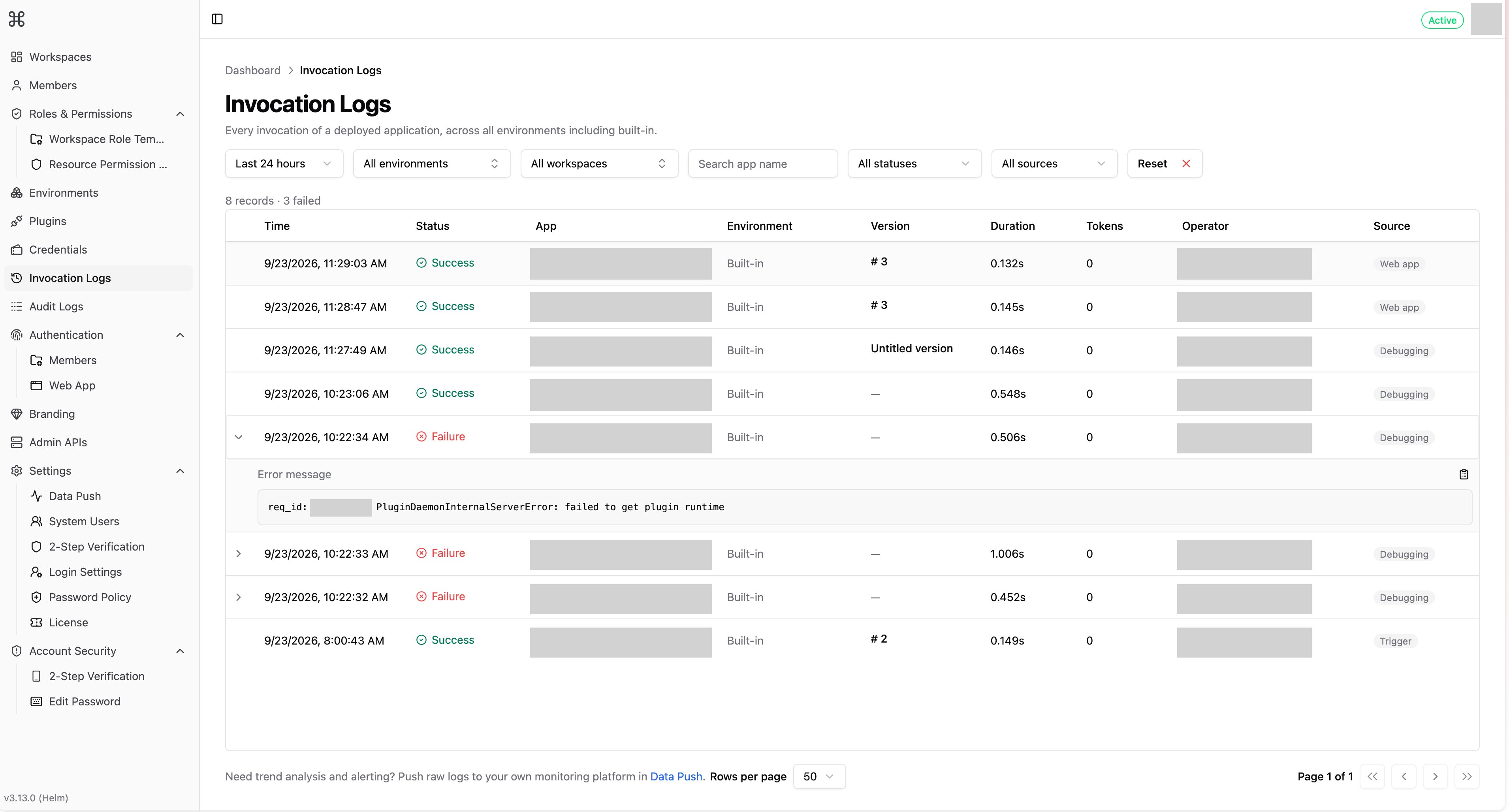 You can find target invocations using the following filters:
* **Time range**: Switch to **Last 7 days**, **Last 30 days**, or **Custom range**.
* **Environment, workspace, status, and source**: Can be combined. Set the status to **Failure** to view only failed invocations.
* **Search app name**: Matches application names containing the search term, case-insensitive.
## Invocation details
The list displays the Time, Status, App, Environment, Version, Duration, Tokens, Operator, and Source for each invocation.
* **Version**: Shows the version name, or its number (`# N`) or **Untitled version** when it has none. `—` means the record has no version.
* **Operator**: Shows the member's name for calls made by a workspace member, the session ID (`session_id`) for web app end users, and the `user` value sent with Service API calls in deployed environments.
Expand a record containing error details to view and copy the **Error message**.
## Log retention
Records from deployed environments are kept for 30 days by default, and a daily cleanup deletes older ones. Built-in records stay in Dify but are hidden once they're older than the retention period. The period applies to every time range, including **Custom range**.
To change the retention period, set `enterprise.appRunnerLog.retentionDays` (`APP_RUNNER_LOG_RETENTION_DAYS`, minimum `1`). Lowering it deletes older deployed-environment records at the next daily cleanup. See [Deployed Environments (App Runner)](/en/3.13.x/deploy/advanced-configuration/environment-variables#app-runner) for the setting.
You can find target invocations using the following filters:
* **Time range**: Switch to **Last 7 days**, **Last 30 days**, or **Custom range**.
* **Environment, workspace, status, and source**: Can be combined. Set the status to **Failure** to view only failed invocations.
* **Search app name**: Matches application names containing the search term, case-insensitive.
## Invocation details
The list displays the Time, Status, App, Environment, Version, Duration, Tokens, Operator, and Source for each invocation.
* **Version**: Shows the version name, or its number (`# N`) or **Untitled version** when it has none. `—` means the record has no version.
* **Operator**: Shows the member's name for calls made by a workspace member, the session ID (`session_id`) for web app end users, and the `user` value sent with Service API calls in deployed environments.
Expand a record containing error details to view and copy the **Error message**.
## Log retention
Records from deployed environments are kept for 30 days by default, and a daily cleanup deletes older ones. Built-in records stay in Dify but are hidden once they're older than the retention period. The period applies to every time range, including **Custom range**.
To change the retention period, set `enterprise.appRunnerLog.retentionDays` (`APP_RUNNER_LOG_RETENTION_DAYS`, minimum `1`). Lowering it deletes older deployed-environment records at the next daily cleanup. See [Deployed Environments (App Runner)](/en/3.13.x/deploy/advanced-configuration/environment-variables#app-runner) for the setting.