> ## Documentation Index
> Fetch the complete documentation index at: https://enterprise-docs.dify.ai/llms.txt
> Use this file to discover all available pages before exploring further.
# Model Providers
> Add model providers to your workspace so your apps can use LLMs, embedding models, and other AI services
Every Dify app needs at least one model provider. Install a provider, add your API key, and all apps in the workspace can use its models.
API keys grant workspace-wide model access and trigger direct billing through each provider's account. Only the workspace owner and admins can manage providers.
## Add a Provider
1. In **Settings** > **Model Provider**, browse the **Install model providers** section or visit the [Marketplace](https://marketplace.dify.ai/) for more options.
2. After installing, click **Setup** on the provider card and enter your API key (and any other required credentials, such as a custom endpoint URL or organization ID). Dify validates the credentials before making the provider available.
## Add a Custom Model
Most providers bring their own models, so once you authorize one, its models are ready to use. You add a model yourself only when the one you need isn't there, typically in two situations:
* You run your own inference server, such as Ollama or Xinference, and Dify has no way to know which models you've loaded.
* A provider lists its models, but the specific one you want, such as a newly released or fine-tuned model, is missing.
Click **Add Model** on the provider card, then give the model a name and its credentials. If a provider only serves a fixed set of models, it won't offer this option.
## Load Balancing
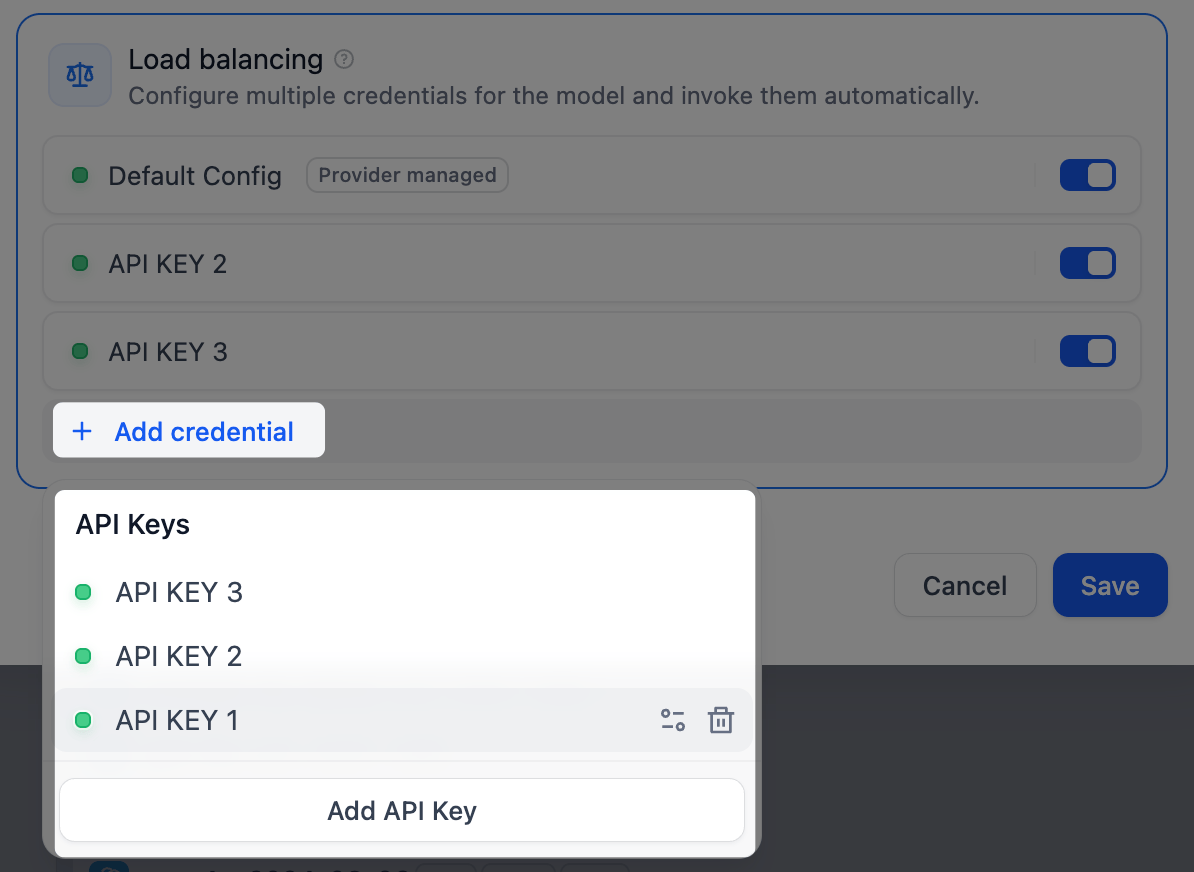
Load balancing lets you configure multiple sets of credentials for a model and distribute requests across them automatically, so no single credential hits its rate limit under heavy use.
By default, Dify uses a round-robin strategy, routing each request to the next credential in the pool. If a credential triggers a rate limit, it is taken out of rotation for one minute before Dify retries it.
To set it up:
1. Find the model, click **Configure**, and open **Load Balancing**.
2. Add credentials to the load balancing pool.
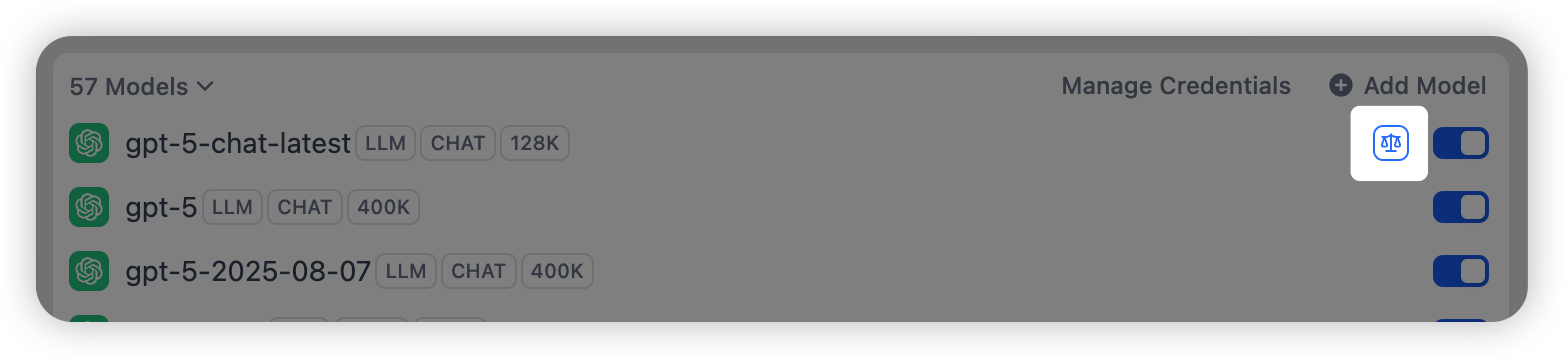
3. Enable at least two credentials, then click **Save**. Models using load balancing are marked with a dedicated icon.
 ## Set Default Models
Click **System Model Settings** in the toolbar to assign the fallback model for each category. Apps and nodes that don't specify a model use these:
* **System Reasoning Model**: the default LLM.
* **Embedding Model**: used for knowledge base indexing and retrieval.
* **Rerank Model**: re-ranks retrieval results by relevance.
* **Speech-to-Text Model**: converts audio input to text.
* **Text-to-Speech Model**: converts text responses to audio.
## Set Default Models
Click **System Model Settings** in the toolbar to assign the fallback model for each category. Apps and nodes that don't specify a model use these:
* **System Reasoning Model**: the default LLM.
* **Embedding Model**: used for knowledge base indexing and retrieval.
* **Rerank Model**: re-ranks retrieval results by relevance.
* **Speech-to-Text Model**: converts audio input to text.
* **Text-to-Speech Model**: converts text responses to audio.